
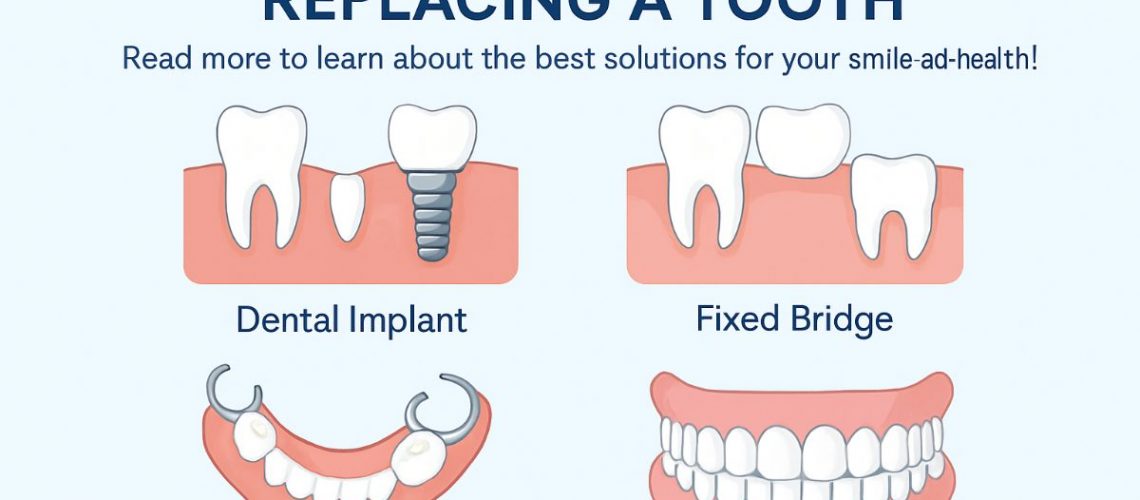
Missing a tooth affects more than your smile. It changes how you chew, how your teeth fit together, and can lead to bone loss over time. This guide outlines the main replacing a tooth options people commonly consider so you can make a clear, practical choice for your health and appearance.
Read on to compare each option, learn what matters when choosing treatment, and see what to expect during recovery. You'll also get a checklist of questions to ask a dentist before you decide.
Comparing common replacing a tooth options
Dental implants
A dental implant replaces both the root and the crown. A titanium post is placed into the jawbone and a crown is attached after healing.
- Pros: Long-lasting, feels and functions like a natural tooth, protects jawbone.
- Cons: Higher upfront cost, requires minor surgery and healing time.
Dental bridges
A bridge spans the gap using crowns on the teeth next to the space or with an implant-supported pontic. It restores appearance and function without placing an implant at the site.
- Pros: Faster finish than some implants, no surgery needed for traditional bridges.
- Cons: Requires altering healthy adjacent teeth, may need replacement every 7–15 years.
Removable partial dentures
Partial dentures are removable plates that replace one or more teeth. They clasp to nearby teeth and sit over the gums.
- Pros: Lower initial cost, non-invasive, easy to modify for more tooth loss.
- Cons: Less stable than fixed options, more maintenance, may affect speech or comfort.
Key factors to consider when choosing among replacing a tooth options
Oral health and bone structure
Your gum health, the amount of jawbone, and the condition of neighboring teeth determine which options are possible. Implants need enough bone; bridges need strong adjacent teeth. Poor gum health often needs treatment first.
Function and appearance needs
Think about how much chewing strength you need and how natural you want your tooth to look. Implants usually offer the best function and most natural feel. Bridges and well-made dentures can look good but may feel different when chewing.
Cost, insurance, and long-term value
Compare upfront cost with expected lifespan and maintenance. Insurance often covers part of bridges or dentures but may limit implant coverage.
- Implants: higher initial cost but can be cost-effective long-term.
- Bridges: moderate cost, may need replacement after a decade or so.
- Dentures: lowest upfront cost, greater ongoing care and possible replacement.
Treatment timeline and recovery
How quickly you want a finished tooth matters. Bridges and dentures can be completed in weeks. Implants often take several months from surgery to final crown because bone needs to heal around the implant.
What to expect during treatment and recovery
Initial exam and imaging
Your dentist will do a clinical exam and take X-rays or a CBCT scan. That shows bone volume, nerve positions, and helps form a treatment plan. You’ll get a clear timeline and cost estimate after this step.
Procedure steps by option
- Implants: Surgery to place the implant → healing and bone integration (weeks to months) → placement of the crown.
- Bridges: Prepare adjacent teeth → take impressions → place a temporary bridge → final bridge cemented in a few weeks.
- Dentures: Impressions → try-ins and adjustments → delivery of the removable partial denture with follow-up fittings.
Aftercare and follow-up
Expect some soreness after any procedure. Implants need good oral hygiene and sometimes a soft-food diet during healing. Bridges and dentures require cleaning and periodic checks. Report increasing pain, swelling, fever, or loose restorations to your dentist right away.
Choosing the right provider and next steps
Ask potential providers about their experience with each option, success rates, and to see photos of past cases. Ask specifically about the expected lifespan of the work, guarantees or warranties, financing options, and whether they coordinate care (for example, with oral surgeons for implants).
Schedule a consultation to review your mouth, get a tailored recommendation, and compare costs and timelines for your situation. A short exam and imaging will make the choices clear and help you pick the best replacing a tooth options for your health and lifestyle.
